
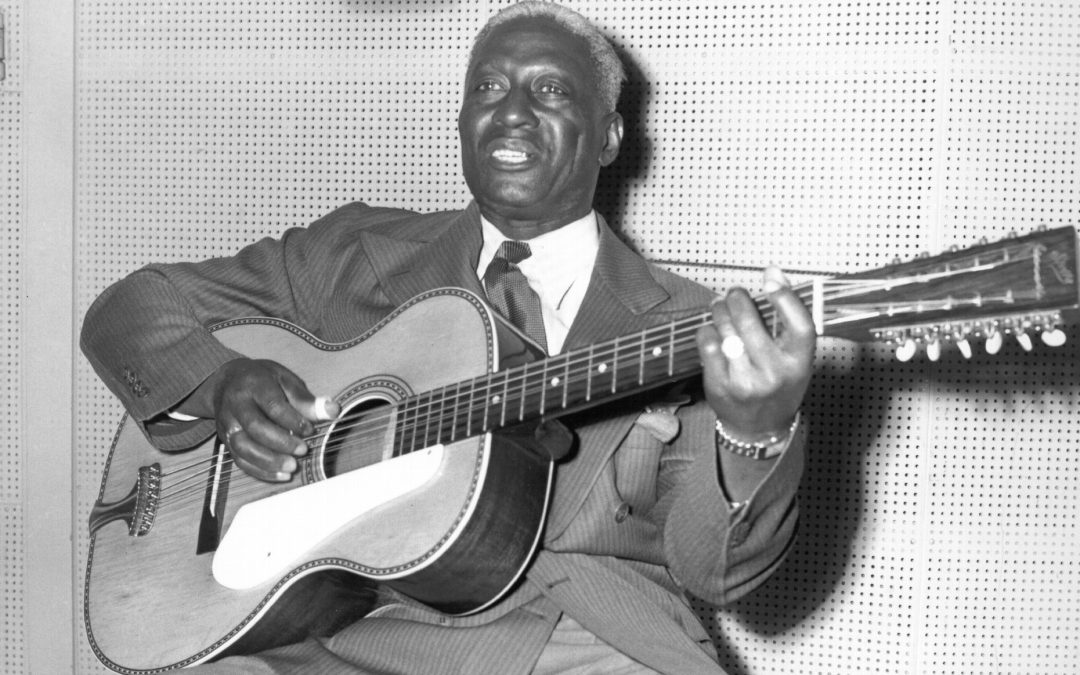
This week Tony and I tuned up the twelve-string! Twelve-string guitars date back to the nineteenth century, and feature 12 strings in six courses (each pair are closely spaced) that produce a thicker and more ringing tone than a standard six-string guitar. Their use in popular music dates back to when recording began, and they have featured on numerous classic recordings over the years.
Lead Belly & The Byrds
Where Did You Sleep Last Night?, also known as “In the Pines” (Roud 3421), “My Girl“, “Hey Girl“, or “Black Girl“, is a traditional American folk song whose authorship is unknown. It dates back to at least the 1870s, and originated in the Southern Appalachian area of United States in the contiguous areas of East Tennessee and Kentucky, Western North Carolina and Northern Georgia. In her 1970 Ph.D. dissertation, Judith McCulloh found over 160 permutations of the song with several lyrical variants. Lead Belly (born Huddie William Ledbetter), an American folk and blues singer known for virtuosity on the twelve-string guitar, recorded Where Did You Sleep Last Night? in 1946. His version was among the most popular, until Nirvana recorded it during the band’s MTV Unplugged appearance, on November 18, 1993.
The Byrds released Eight Miles High in 1966, and included it on their third album Fifth Dimension. The song was written by Gene Clark, Jim McGuinn (later known as Roger McGuinn), and David Crosby, and was subject to a U.S. radio ban shortly after release due to percieved drug connotations in the lyrics. The song’s failure to reach the Billboard top ten was attributed to this broadcasting ban; Eight Miles High reached number 14 on the Billboard Hot 100 chart, number nine on Canada’s RPM chart, number 16 on the New Zealand listener chart, and number 24 on the UK Singles Chart. The lyrics are for most part about the group’s flight to London in August 1965 and accompanying English tour; commercial airliners fly at altitude of six to seven miles, but “eight miles high” sounded more poetic than six, and also reportedly alludes to the Beatles‘ song Eight Days a Week. Jim McGuinn’s twelve-string guitar solo was inspired by John Coltrane’s song India from his album Impressions (1963) as well as Ravi Shankar’s sitar playing.
Gordon Lightfoot & Melissa Etheridge
Sundown by Gordon Lightfoot is from his ninth album of the same name, released in March 1974. Sundown was his only album to reach number one on the pop charts in the U.S., and it topped the RPM 100 chart in his native Canada for five consecutive weeks. The song also topped the charts: it reached number one on U.S. Billboard Hot 100 and easy listening charts, number 13 on the Hot Country singles chart, and number one in Canada on RPM’s national singles chart. Lightfoot plays his Gibson B-45-12 twelve-string guitar, the same instrument pictured on the album cover, on Sundown‘s intro. Red Shea recorded the lead guitar and solo parts of the song on a tobacco sunburst 1969 Gibson Les Paul Custom with a Bigsby vibrato bar plugged into a cranked Fender Silverface Twin Reverb with the tremolo on a low setting. Gordon Lightfoot is widely considered to be one of Canada’s greatest songwriters, and was a featured musical performer at the opening ceremony of the 1988 Winter Olympics in Calgary.
Melissa Etheridge released Like The Way I Do as the second single from her first album, Melissa Etheridge (1988). The album was an underground success, and peaked at number 22 on the Billboard Top 200; the albyum’s lead single Bring Me Some Water was nominated for a Grammy (Best Rock Vocal Performance, Female) in 1989. Like The Way I Do was written years before the album was recorded, and Etheridge had already played it during live concerts, where it was the first of her own compositions to be requested by her audience. The song’s intro was created by coincidence when Etheridge played her other song I Want You backwards on a cassette recorder in the studio, and the twelve-string guitar used in the track is an Ovation roundback guitar with a fibreglass composite body.
Johnny Cash & Eslabón Armado and Peso Pluma
The Man Comes Around is the title track from American IV: The Man Comes Around (2002), the final album released in Johnny Cash’s lifetime. It was written several years prior to release of the album, and was one of the last songs Cash wrote before his death in 2003. The song was reportedly inspired by a dream Cash had about Queen Elizabeth II, in which the Queen compared Cash to “a thorn tree in a whirlwind.” Haunted by the dream, Cash became curious if the phrase was a biblical reference, and eventually found a similar phrase in the Book of Job: “Then the Lord answered Job out of the whirlwind”. The Man Comes Around is thus full of biblical references: a spoken portion from Revelation 6:1–2 in the King James Version introduces the song; Cash describes coming of the Four Horsemen of the Apocalypse; “the man” in question is inferred to be Jesus Christ on the day of judgement; the chorus mentions trumpets (as in Revelation 8, 9, 11), pipers (Rev. 18:22), and “one hundred million angels singing” (Revelation 1:10; 4:1; 8:13, and 5:11). Cash uses a twelve-string guitar to musically emphasise each refrain: “There’ll be a golden ladder reachin’ down… When the man comes around”.
Ella Baila Sola is a song by American band Eslabón Armado and Mexican singer Peso Pluma released in 2023. Eslabón Armado are a regional Mexican group formed in 2017 in Patterson, California. The original lineup consisted of Pedro Tovar (lead vocals), Brian Tovar (bass), and Jesse Vargas (backing vocals and acoustic guitar); Vargas left in 2020, and Ulises González (acoustic guitar) and Damián Pacheco (twelve-string guitar) joined in 2022. Peso Pluma is a Mexican singer and rapper recognized for his work in regional Mexican music, particularly corridos tumbados. Ella Baila Sola was written by Pedro Tovar and produced by Tovar with Ernesto Fernández, and was released as the lead single from Desvelado (2023), the group’s sixth studio album. The song debuted in the top 30 of the Billboard Hot 100 chart, and has sold 240,000 units in the U.S. alone (and has earned multi-platinum certification from the Recording Industry Association of America).
Katy Perry v Kesha

Our soundslike this week looked at some similarities in the choruses of Kesha‘s debut single TiK ToK (2009), and California Gurls by Katy Perry featuring Snoop Dogg (2010). Any similarity is, of course, ascribable to coincidence – and the fact both songs were co-written by the same people!
Twelve-string Quiz
For our quiz this week, you heard famous songs featuring a 12-string guitar – guess the artist and song!
As always, find the show and blog at joebennett.net/5live, with occasional Instagram extras at @joebennettmusicology. With a new show comes a new Spotify mega-playlist, which contains all songs featured on the show:
And you can still listen to our old mega-playlist here.
- Words: Joe Bennett, John Pierce O’Reilly
- Audio production: Joe Bennett, Rafi Waters
Recent Comments