
This week Tony and I explored the Andalusian cadence! The Andalusian cadence is a descending harmonic pattern, most commonly i–♭VII–♭VI–V in minor keys, with roots in flamenco and earlier Iberian traditions. It has been used throughout classical music, jazz, pop, rock, and country, and it continues to be a useful harmonic tool for songwriters. Tonight on the show we traced how this same harmonic idea reappears across nearly a century of recorded music.
Duke Ellington & Nina Simone
One of the earliest uses of the word “swing” in popular music, It Don’t Mean a Thing is built around a clear Andalusian cadence (Fm–E♭–D♭–C). The song was written in 1931 by Duke Ellington, with lyrics credited to trumpeter Bubber Miley, and was first recorded in 1932 with Ivie Anderson on vocals. The descending progression provides a repeating, grounded framework over which Ellington’s band improvise. The original 1932 recording was inducted into the Grammy Hall of Fame in 2008.
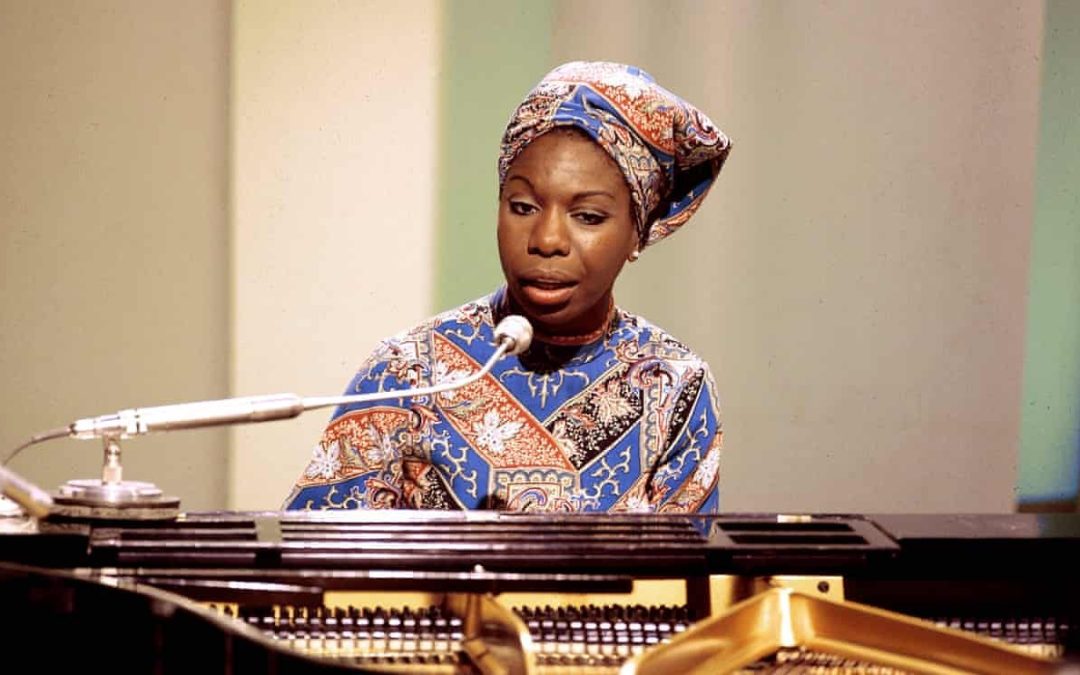
First recorded by Nina Simone for her album Broadway-Blues-Ballads in 1964, Don’t Let Me Be Misunderstood uses the Andalusian cadence throughout its verses (Bm–A–G–F♯). The song was written by Bennie Benjamin, Horace Ott, and Sol Marcus, and has been covered extensively in the years following Simone’s recording by artists including The Animals to Santa Esmeralda. Santa Esmerelda’s 1977 extended version of Don’t Let Me Be Misunderstood became an international hit, reached no. 15 on the US Billboard Hot 100, and helped to define the late-1970s disco-flamenco crossover.
Christina Aguilera & Muse
Genie in a Bottle (1999) opens with the Andalusian cadence spelled out clearly on a MIDI-style keyboard (Fm–E♭–D♭–C), establishing its harmonic identity immediately. The song was released as the lead single from Christina Aguilera’s debut album, and pairs the familiar descending pattern with late-1990s pop production and a (for Aguilera) restrained vocal delivery. Genie in a Bottle went to No. 1 in a then-record 21 countries, spent five weeks at No. 1 on the Billboard Hot 100, and is certified triple Platinum by Recording Industry Association of America
.
In Muse‘s Citizen Erased (2001), the Andalusian cadence is initially implied rather than fully stated, with open fifths and a sustained bass pedal obscuring the harmony. When the vocals enter, the progression resolves clearly into the characteristic minor descent. Written by Matt Bellamy and featured on the band’s second studio album Origin of Symmetry, the song uses the cadence as part of a larger, multi-section structure rather than as a repeating pop loop.
Carrie Underwood & Annabelle Dinda
Carrie Underwood‘s iconic revenge song Before He Cheats is driven by an Andalusian cadence (F♯m–E–D–C♯) throughout the verses. The song was written by Chris Tompkins and Josh Kear, and released as the fourth single from Underwood’s debut album Some Hearts (2006). Before He Cheats song topped the Billboard Hot Country Songs chart for five consecutive weeks, crossed into pop radio with top-ten placements on the Mainstream Top 40 and Adult Contemporary charts, and peaked at No. 8 on the Billboard Hot 100, where it remained for 64 weeks – one of the longest runs in the chart’s history. It became the first country song to sell over two million digital copies and was, for a time, the best-selling country single of all time. At the 50th Grammy Awards, Underwood won Best Female Country Vocal Performance, while Tompkins and Kear received Best Country Song.
The Hand is a song built around a clear Andalusian cadence (Cm | B♭| A♭| Gm in this case, so the V chord is minor) written by Annabelle Dinda and released in 2025. Dinda first introduced the track via TikTok performances, where it gained traction as a commentary on gendered experience and the idea of the “male gaze,” a concept articulated in film theory by Laura Mulvey in the 1970s. The song was written, performed, and produced independently by Dinda, who has been self-releasing music since 2020, and represents a fully DIY approach to songwriting and distribution. “The Hand” became her breakout release, with clips related to the song significantly outperforming her typical engagement levels on social media.
ABBA vs The Pretenders

Our soundslike this week explored a melodic and harmonic similarity between The Winner Takes It All by ABBA (1980), and I’ll Stand By You by The Pretenders (1994).
Andalusian Cadence Quiz
For our quiz this week, you heard famous songs that contain an Andalusian Cadence (backwards) – guess the artist and song!
As always, find the show and blog at joebennett.net/5live, with occasional Instagram extras at @joebennettmusicology. With a new show comes a new Spotify mega-playlist, which contains all songs featured on the show:
And you can still listen to our old mega-playlist here.
- Words: Joe Bennett, John Pierce O’Reilly
- Audio production: Joe Bennett, Rafi Waters
Recent Comments